Categories
Litigation Tips

Contractual Limitation of Liability Provisions in California Supreme Court

In a landmark decision issued on April 24, 2025, the California Supreme Court ruled that contractual clauses limiting liability for intentional torts are unenforceable under California Civil Code § 1668.  The case, New England Country Foods, LLC v. VanLaw Food Products, Inc. (S282968), arose when NECF accused VanLaw of intentionally misappropriating its barbecue sauce recipe to sell directly to Trader Joe’s, violating their manufacturing agreement.  VanLaw sought to dismiss the claims based on a contract clause limiting damages, but the Court held that any provision attempting to limit liability for willful injury is invalid, regardless of the parties’ sophistication or the clause’s scope.


This decision clarifies that while limitations on liability for ordinary negligence may be enforceable under certain conditions, any attempt to contractually limit damages for intentional misconduct is categorically prohibited.


Read the full opinion here.
Categories
Announcements

Lewis & Llewellyn Attorneys Attend NITA Skills Courses

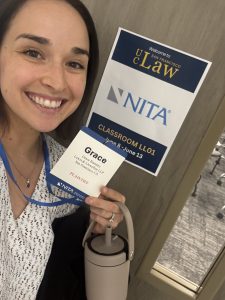
Lewis & Llewellyn attorneys, Rina Plotkin and Grace Ramirez, recently completed National Institute for Trial Advocacy’s (NITA) deposition skills course.  NITA’s courses provide lectures and demonstrations on deposition-taking techniques and are considered the gold standard in teaching trial advocacy.  Attorney Zachary Flood also attended the NITA trial skills course last week in San Francisco.  We look forward to seeing his enhanced skills in action.

Categories
Announcements

Lewis & Llewellyn and the State of AI

AI is transforming the modern litigator’s toolkit.  Today’s AI tools can accelerate research, analyze deposition transcripts, and help organize complex case data.  However, they face a critical limitation—confidently citing nonexistent cases or misapplying legal principles.  Most of these tools are trained on general data and often lack the structured legal reasoning essential to our practice.


Ethics opinions from the ABA and state bars caution that attorneys must supervise AI use, understand its limitations, and independently verify all outputs.  Our professional duties of competence, confidentiality, and candor remain unchanged regardless of how fast or convenient these tools may be.


At Lewis & Llewellyn, we’re taking a proactive approach.  We use AI to augment—not replace—judgment.  And we’re investing in knowledge management so our teams can work more collaboratively with technology, turning our collective expertise into a strategic advantage.  This enables us to deliver high-quality, cost-effective results for our clients while maintaining the standards of care and oversight required by the profession.


The future is promising.  As better legal datasets and frameworks emerge, AI will evolve into a more reliable litigation partner.  Until then, the key is thoughtful implementation, harnessing AI’s efficiency while preserving the ethical and analytical foundations of effective advocacy.


Lewis & Llewellyn attorney Nitesh Daryanani was recently featured on the Young Scholars Initiative’s LinkedIn to discuss how AI is changing the legal landscape.  The video can be viewed on LinkedIn here.  Stay tuned for more updates on AI and other developments in the legal industry.

Categories
Announcements

Partner Evangeline A.Z. Burbidge Published in the Daily Journal Top Women Lawyers 2025 Supplement

Partner Evangeline A.Z. Burbidge was recently published in the Daily Journal’s Top Women Lawyers 2025 Supplement.  In the article Helping Women Thrive in Law: What Every Firm Needs to Know About Retention and Equity, Evan emphasizes the importance of flexibility, transparent leadership, mentoring, and fair credit for business development to foster a more equitable and successful work environment for all.


The full article can be read here.

Categories
Announcements

Lewis & Llewellyn Welcomes Taylor Tsan as Our 2025 Annual Fellow

Three years ago, Lewis & Llewellyn launched its Annual Fellowship to remove barriers and create opportunities for talented individuals with diverse experiences in the legal industry.


We are pleased to welcome Taylor Tsan to the firm as our fellow for 2025.

Taylor is a fourth-year student at UC Berkeley studying political science and Asian American & Asian Diaspora Studies.  She’s the president of the Cal Debate Team and assists with research on the World War II incarceration of Japanese Americans.


We are thrilled to have Taylor as a part of our team this summer, and we look forward to continuing to provide a space for young adults to explore their interest in the law.

Categories
Announcements

Partner Becca Furman Celebrates 10 Years with Lewis & Llewellyn

Lewis & Llewellyn would like to congratulate Partner Becca Furman on her 10-year anniversary with the firm.

Becca joined Lewis & Llewellyn in 2015 as a second-year associate and, over the last 10 years, she has developed a pragmatic and creative litigation style that is appreciated by both clients and colleagues.


Becca’s practice focuses on complex trade secret and commercial litigation disputes involving cutting-edge technology.  Just last year, Becca and the L&L team obtained a case-dispositive summary judgment ruling on the eve of trial in which the plaintiff was seeking hundreds of millions of dollars. Immediately following that case, Becca resolved a case for two clients who were accused of trade secret misappropriation by a major EV company.


Becca was elevated to partner in 2021 and is someone clients and the L&L team turn to time after time for guidance and expertise.


We are grateful to have Becca on our team, and we are looking forward to her next 10 years with Lewis & Llewellyn!

Categories
Litigation Tips

CCP Section 998 Cost-Shifting Ruling

Most practitioners understand the game theory aspect of Section 998 offers.  But the rules have changed slightly.  In March, the California Supreme Court held that if a plaintiff rejects a 998 settlement offer, they can then be liable for costs and fees if they later settle before trial.  Importantly, this decision clarifies that Section 998 applies not just to trial outcomes but also to pre-trial settlements.


The ruling underscores that while parties can negotiate their own cost allocations in settlement agreements, Section 998’s default rules apply if such terms are not specified. This decision reinforces the statute’s purpose of encouraging reasonable pre-trial settlements by shifting costs to parties who reject favorable offers and later secure less favorable outcomes.  In other words, if a plaintiff rejects a 998 offer and then “fails to obtain a more favorable judgment or award,” Section 998 overrides the usual rule that a prevailing plaintiff can recover costs.  The case highlights the strategic importance of Section 998 offers in California litigation, serving as a powerful tool to leverage settlements and manage costs.